
Lithium Battery Protection Board: Buyer’s Guide
What a lithium battery protection board does
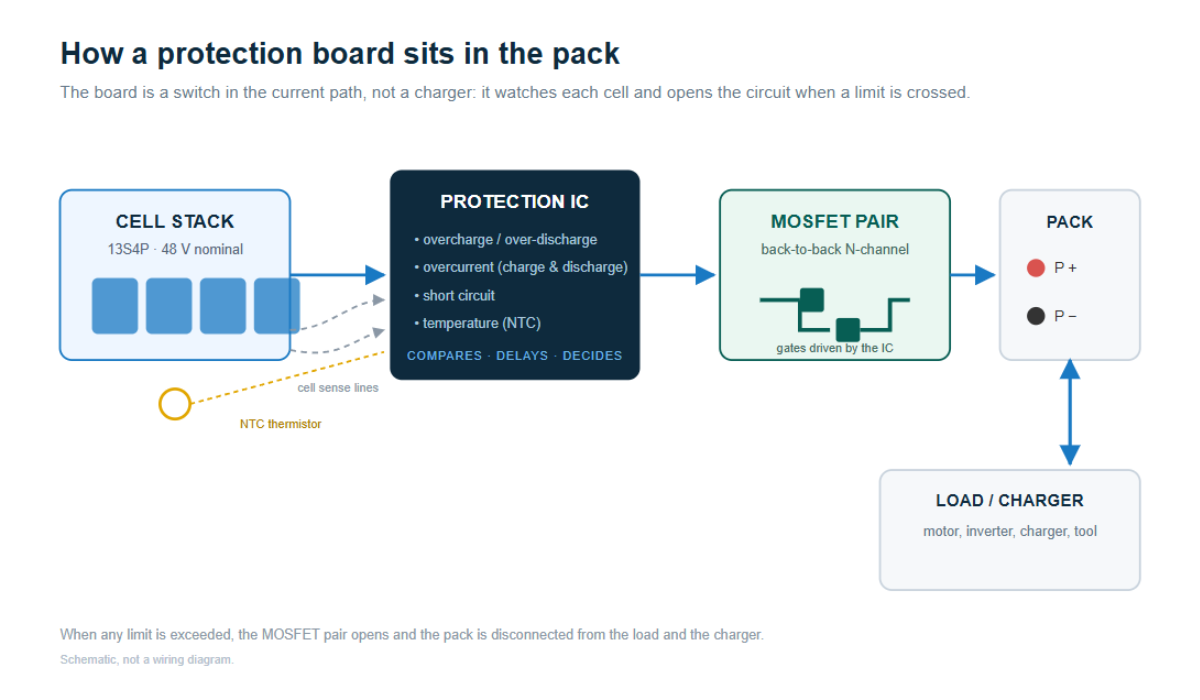
A lithium battery protection board — also called a protection circuit module (PCM) or simply a BMS board — is the circuit between the cells and everything outside the pack. It watches cell voltage, pack current and temperature, and it opens the circuit when any of them leaves the safe window. The cells themselves cannot do this. A lithium cell that is over-discharged past roughly 2.0 V will not recover its capacity, and a short circuit on a bare pack can reach hundreds of amps in milliseconds.
In a well-built pack the protection board is the last line of defence. It is not a charger and it is not a fuel gauge; it is a switch with rules.
The board typically provides five protections:
- Overcharge — cuts charging when any cell exceeds its upper voltage limit.
- Over-discharge — cuts the load before cells fall below the lower limit.
- Overcurrent — limits discharge and charge current to what the cells and wiring can take.
- Short circuit — trips within microseconds, far faster than a fuse responds.
- Temperature — uses an NTC thermistor to stop charge or discharge when the pack is too hot or too cold.
Cell balancing is a separate function. Many protection boards include passive balancing, but a basic board without balancing will still protect the pack — it just will not keep the cells in step over hundreds of cycles.
How the board makes a decision
A protection IC measures each cell through a resistor divider, compares the result against fixed thresholds, and drives a pair of N-channel MOSFETs on the negative side of the pack. When a threshold is crossed for longer than the built-in delay, the MOSFET turns off and the pack is disconnected.
Two details separate a good board from a cheap one:
- Delay times are deliberate. A short circuit trips in microseconds, overcurrent in milliseconds, and over-discharge can wait seconds. A board that trips too eagerly will cut power to a motor at startup; one that waits too long will let a MOSFET die.
- Recovery behaviour differs. Some boards recover automatically when the fault clears; others latch and need a charger connected or a power cycle. For equipment that runs unattended, this is the difference between a self-healing pack and a service call.
Protection board vs smart BMS
The two terms are used loosely. In practice they describe different levels of capability:
| Function | Basic protection board (PCM) | Smart BMS |
|---|---|---|
| Overcharge / over-discharge / overcurrent / short circuit | Yes | Yes |
| Temperature protection | Usually | Yes, multiple sensors |
| Cell balancing | Passive, often 30–100 mA | Passive or active |
| State of charge / state of health | No | Yes |
| Communication (UART, RS485, CAN) | Rare | Standard |
| Fault logging and firmware update | No | Usually |
| Relative cost | Low | 3–10× higher |
If the product only needs to be safe and cheap — a power tool pack, a small e-bike battery, a portable speaker — a protection board is the right answer. If the pack reports data to a vehicle, a charger or a fleet platform, you need a smart BMS.
Same-port vs separate-port
This is the first thing to decide, and it is usually decided by the charge and discharge currents.
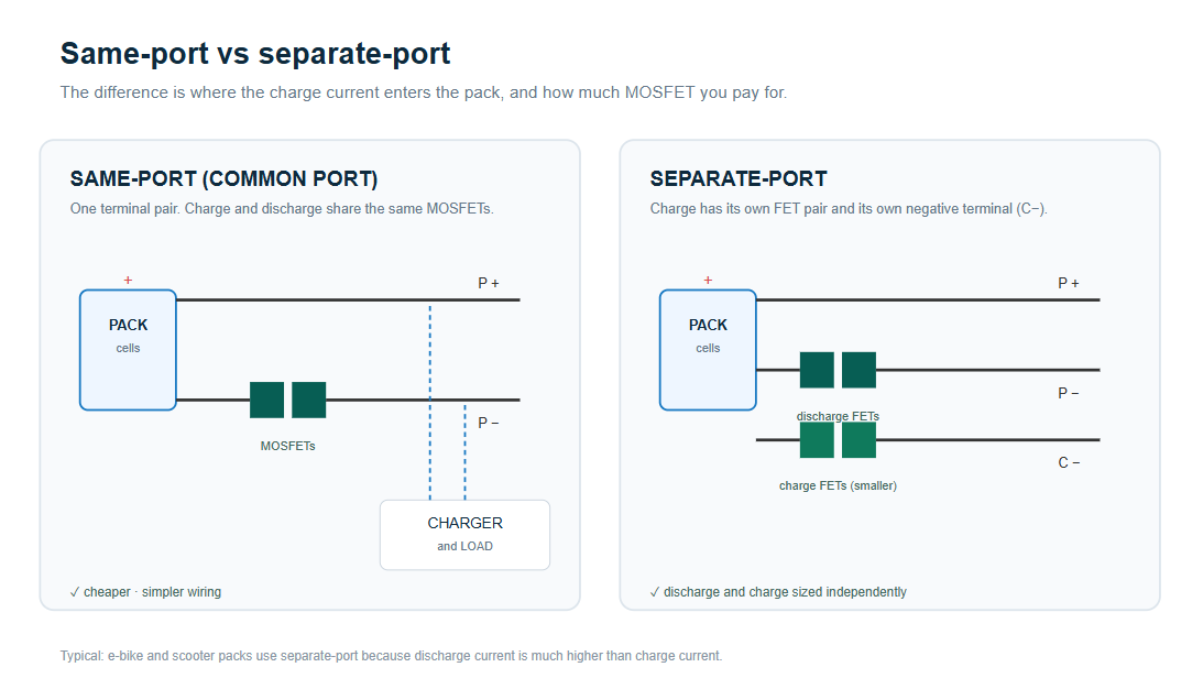
- Same-port (common port): charging and discharging share one pair of terminals and the same MOSFETs. Cheaper and simpler to wire, but the charge current is limited by the discharge FETs, which are sized for the larger of the two currents.
- Separate-port: the charge path has its own, smaller MOSFET pair. It costs a little more and needs an extra terminal, but it lets a pack discharge at 60 A while charging at 5 A without oversizing the charge FETs.
Most e-bike and scooter packs use separate-port boards because the ratio between discharge and charge current is large. Small consumer packs usually use same-port.
Thresholds depend on the chemistry
Never assume a board is “for lithium” in general. A board configured for NMC will overcharge a LiFePO4 pack if you swap chemistries without changing the thresholds.
| Parameter | NMC / Li-ion (per cell) | LiFePO4 (per cell) |
|---|---|---|
| Overcharge cut-off | 4.20–4.25 V | 3.60–3.65 V |
| Overcharge release | 4.05–4.15 V | 3.45–3.55 V |
| Over-discharge cut-off | 2.80–3.00 V | 2.00–2.50 V |
| Over-discharge release | 3.00–3.20 V | 2.50–2.80 V |
These are typical values, not a specification. The cell datasheet always wins — a high-rate cell may need a higher cut-off, and a pack that must work at −20 °C may need a wider window with temperature compensation.
Sizing the board for real current
The number printed on the board is a laboratory rating. In an enclosure at 45 °C it is not the number you should design to.
- Continuous vs peak. A motor that draws 20 A continuously can pull 60 A for a fraction of a second at startup. The board must survive the peak and hold the continuous.
- Derate. Plan for 70–80 % of the rated current in still air, less in a sealed case.
- Heat is the real limit. MOSFET loss is I²R. Doubling the current quadruples the heat; two MOSFETs in parallel halve the on-resistance, which is why current ratings are usually quoted per number of FETs.
- Check the whole path. A 60 A board with 20 A wiring, a 30 A connector and a 40 A fuse is a 20 A pack.
Passive or active balancing
Passive balancing bleeds energy from the highest cell through a resistor, typically 30–100 mA, and mostly near the top of charge. It is cheap, reliable, and enough for packs that are assembled from matched cells and cycled gently.
Active balancing moves charge between cells and can handle larger imbalances with less heat. It matters for long series strings, for LFP packs with a flat voltage curve, and for packs that must stay in service for many years. It also costs more and adds failure points.
If a pack shows the same weak cell every cycle, balancing is not the fix — the cell is. Balancing corrects drift, not a bad cell.
When you need communication
A protection board can be completely silent. Add communication only when something downstream needs the data:
- UART / I²C — short-range, board-to-controller inside the product.
- RS485 — multi-drop, common in stationary storage and industrial packs.
- CAN — vehicles, chargers and inverters that expect a standard battery message set.
The data that justifies the cost is usually cell voltages, pack current, temperature, state of charge, cycle count and fault history. If the answer to “who will read this?” is “nobody”, skip it.
Failure modes worth designing against
- Undersized MOSFETs. The board works on the bench and fails in summer. Check RDS(on) at 100 °C, not 25 °C.
- Inrush current. Plugging a pack into a large capacitor bank looks like a short circuit. Some boards trip; some die. Pre-charge or a soft-start input is cheaper than a return.
- Reverse connection. A board without reverse-polarity protection will pass the fault straight to the cells.
- Moisture. Conformal coating is not optional for outdoor packs; condensation on the sense pins causes phantom trips.
- Wrong thresholds. A LiFePO4 pack on an NMC board is a warranty claim waiting to happen.
- Latch vs auto-recovery. Match the recovery behaviour to how the product is used, not to what the board happens to do.
What to send for a quotation
A protection board quote is only as good as the inputs. Send these and the reply will be a specification instead of a question:
- Chemistry (NMC, LFP, LTO) and series/parallel configuration
- Continuous discharge current, peak current and duration
- Charge current and charge voltage
- Same-port or separate-port
- Balancing required or not, and balancing current if specified
- Communication interface, if any
- Board dimensions, connector type and mounting method
- Operating temperature range and ingress protection
- Certification and documentation requirements
- Sample quantity and annual volume
Our battery pack RFQ checklist covers the pack-level inputs that sit around the board.
Frequently asked questions
Can I use a 4S protection board on a 3S pack?
No. The sense inputs and thresholds are wired for a fixed cell count. A 4S board on a 3S pack will either not start or will misfire on the missing cell.
Does a protection board balance the cells?
Only if the datasheet says so. Many basic boards have no balancing at all; others include 30–100 mA passive balancing. Check before you assume.
Why does my board get hot at half its rated current?
Because the rating was measured with the board in open air, and your enclosure is not open air. Heat rises with the square of current and with MOSFET on-resistance, which itself rises with temperature.
Same-port or separate-port for an e-bike pack?
Separate-port is the usual choice, because discharge current is much higher than charge current and you do not want to size the charge FETs for the motor.
Is a protection board the same as a BMS?
In casual use, yes. Technically a protection board is the safety layer; a BMS also estimates state of charge, balances actively and communicates. Our BMS selection guide walks through the difference in more detail.
Next step
If you are specifying a protection board for a new pack, send the list above and we will come back with a matched board and a pack-level proposal. If you already have cells and a housing, we can work from your drawing.
Browse battery protection boards or start a custom battery project — WhatsApp.