
How to Specify a BMS Protection Board for a 4S Pack
Four cells in series is the most common small-pack configuration there is: 14.8 V nominal from NMC, 12.8 V from LiFePO4, enough to run a handheld tool, a medical device or a 12 V-class motor. It is also the configuration where buyers most often specify the protection board by current rating alone — and then discover the pack shuts down early, runs hot, or refuses to charge on a cold morning.
This is the specification order that avoids those three failures: configuration first, then current, then topology, then the details that only show up in validation.
Start with the stack, not the board
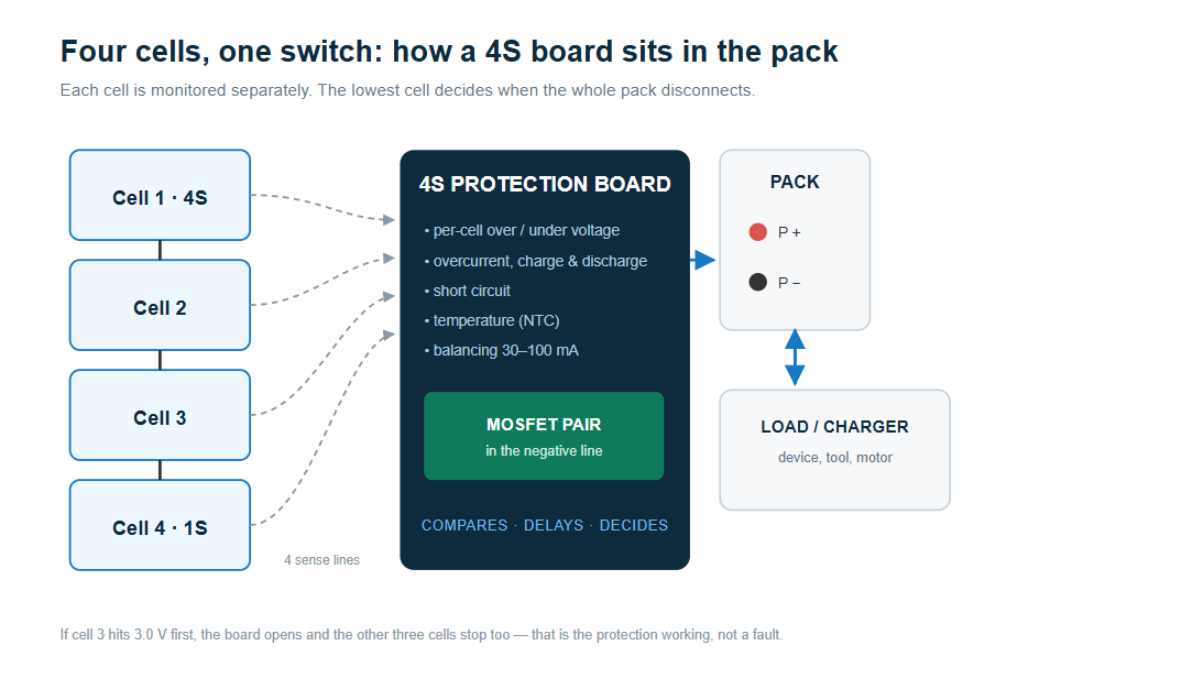
A 4S board does not have a single voltage limit. It has four independent cell limits, checked continuously, and one pack-level consequence: if any cell crosses a threshold, the whole string is disconnected.
That matters because the pack is only as good as its weakest cell, and at 4S a single lazy cell will trip the board long before the pack is actually empty.
| Parameter (4S) | NMC / Li-ion | LiFePO4 |
|---|---|---|
| Nominal pack voltage | 14.8 V | 12.8 V |
| Overcharge cut-off (per cell) | 4.20–4.25 V | 3.60–3.65 V |
| Full pack voltage at cut-off | 16.8–17.0 V | 14.4–14.6 V |
| Over-discharge cut-off (per cell) | 2.80–3.00 V | 2.00–2.50 V |
| Empty pack voltage at cut-off | 11.2–12.0 V | 8.0–10.0 V |
These are typical values. The cell datasheet always wins, and a pack that has to operate below 0 °C may need a different window entirely.
Then fix the current — in three numbers, not one
A board quoted as “4S 40 A” tells you one thing: the number the supplier measured on a bench. Your pack needs three:
- Continuous discharge — what the device draws for minutes at a time.
- Peak discharge and its duration — motor inrush, radio transmit bursts, camera flash. A 3-second 90 A pulse is a different requirement from 90 A continuous.
- Charge current — usually 0.3–0.5 C for a small pack, and the number that decides same-port versus separate-port.
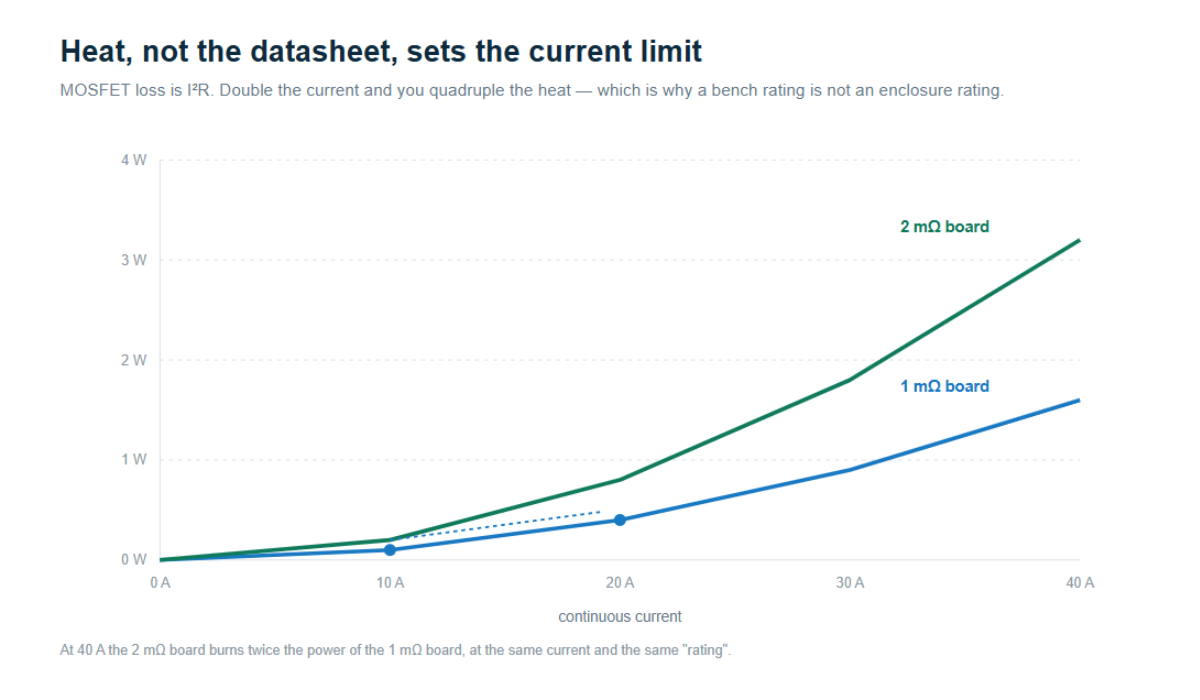
Size the board at 70–80 % of its rated continuous current if it sits in a sealed enclosure. MOSFET loss is I²R, on-resistance rises with temperature, and a board that is comfortable on a bench at 25 °C is not the same board inside a moulded case at 45 °C.
Same-port or separate-port for a 4S pack
The choice is decided by the ratio between discharge and charge current.
- Same-port — one terminal pair, one set of MOSFETs. Cheaper and simpler. Fine when charge and discharge currents are close, which is typical for consumer devices, medical instruments and backup packs.
- Separate-port — charging gets its own FET pair and its own negative terminal (C−). Worth it when discharge is much higher than charge: e-bike and scooter packs, power tools, anything with a motor.
Rule of thumb for 4S: if charge current is under a third of continuous discharge, separate-port usually pays for itself in board size and heat.
Balancing: at 4S, yes
Four cells drift. Passive balancing of 30–100 mA, active near the top of charge, is enough for most 4S packs and costs very little. Without it, one cell reaches cut-off first every cycle and the pack loses capacity a few percent at a time.
Two things to specify if balancing matters to you: the balancing current, and whether balancing runs only during charge. Some boards bleed continuously, which is a slow drain on a pack that sits on a shelf.
Communication: only if something reads it
A 4S board can be completely silent. Add UART, RS485 or CAN only when a device downstream needs cell voltages, state of charge, temperature or fault history — a display, a charger, a service tool, a fleet platform.
If the answer to “who reads this data?” is nobody, the interface is cost and a failure point.
The details buyers forget until validation
- Board footprint. The board has to fit the space left by the cells and the connector, with clearance for the FETs and their heat. Ask for a dimensioned drawing, not a photo.
- NTC placement. The thermistor must touch the cells, not the board. A sensor sitting on the PCB reports board temperature and misses a hot cell entirely.
- Wire gauge and connector. A 40 A board with 18 AWG leads is a 15 A pack. Match the whole path: board, leads, connector, fuse.
- Mounting. Vibration loosens screws. Ask how the board is fixed and whether there is a conformal coating for humid or outdoor use.
- Recovery behaviour. Auto-recovery or latch? For a device that runs unattended, this decides whether a fault becomes a service call.
A worked example: 4S2P 18650 for a portable device
| Item | Value |
|---|---|
| Configuration | 4S2P, 18650, 3,500 mAh cells |
| Pack | 14.8 V nominal, 7.0 Ah, ~104 Wh |
| Continuous discharge | 10 A |
| Peak discharge | 25 A for 5 s |
| Charge current | 3 A |
| Board | 4S, same-port, 15 A continuous, 30 A peak |
| Balancing | Passive, 50 mA, charge only |
| Temperature | NTC bonded to cell group, 0–45 °C charge window |
The board is specified above the pack’s continuous current (15 A vs 10 A) because the pack lives in a sealed case. It is not oversized for the peak: the 30 A rating covers a 5-second 25 A burst with margin.
What to send for a quote
- Configuration (4S1P, 4S2P, cell model) and chemistry
- Continuous and peak discharge with duration
- Charge current and charge voltage
- Same-port or separate-port
- Balancing required, and balancing current
- Communication interface, if any
- Board dimensions available in the enclosure
- Connector type, wire length and gauge
- Operating temperature range and ingress protection
- Sample quantity and annual volume
The battery pack RFQ checklist covers the pack-level inputs that sit around the board, and the BMS selection guide goes deeper on chemistry and communication.
FAQ
Can I use a 3S board on a 4S pack?
No. The sense inputs are wired for a fixed cell count; a 3S board on a 4S pack will either not start or will misread the stack.
Does a 4S pack need balancing?
It benefits from it. Four cells drift and the weakest one decides when the pack cuts off. Passive balancing at 30–100 mA is cheap insurance.
Why does my board cut off at 12 V when the cells are still at 3.0 V?
Because one cell is lower than the others. The board protects the lowest cell, not the pack average.
Can a 4S board run a 12 V motor directly?
Only if the motor’s startup surge stays inside the board’s peak rating and duration. Check the inrush, not the nameplate current.
What is the difference between the board’s 4S rating and a 4S BMS?
In casual use, nothing. Technically the board is the protection layer; a BMS may also report state of charge and communicate. See the protection board guide.
Next step
Send the ten inputs above and we will come back with a matched board and a pack-level proposal. Browse battery protection boards or start a custom battery project — WhatsApp.